
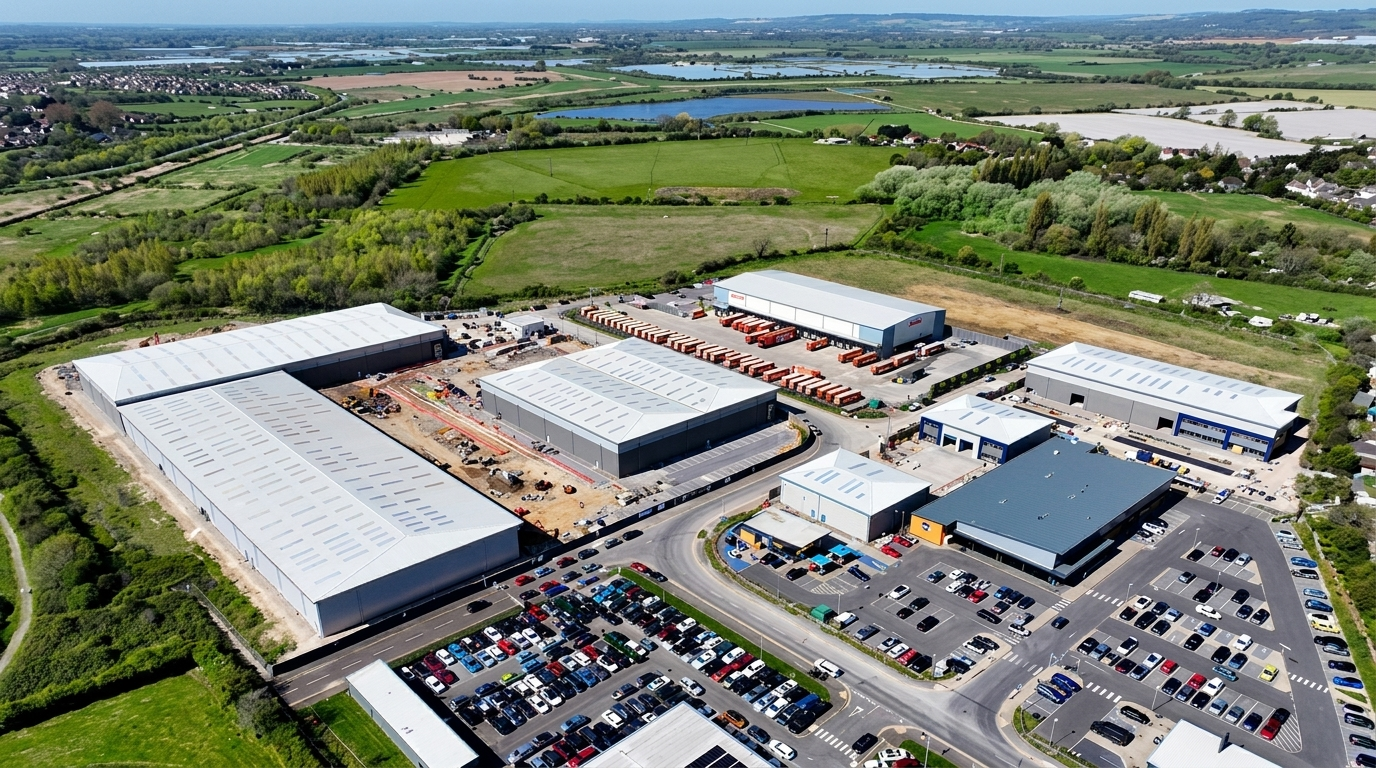
Eleven units. One availability date. A builders clean on an industrial scheme this size runs to the build programme rather than around it, so every phase has to land in sequence and hold its finish while other trades are still moving through the building. SSH Cleaning worked at Saltbox in Bognor Regis through July and into August 2026, on a development delivered by Mildren Construction for Kier Property. The scheme covers 204,993 sq ft across 11 logistics and trade counter units.
Four separate builders clean phases were specified, each with its own method, its own access requirement and its own slot in the programme. This is what the work involved and the thinking behind the order it ran in.
The scheme: 11 units, two brands, one enterprise zone
Saltbox sits on Shripney Road, inside Saltbox Business Park. Kier Property started on site in August 2025, with the units set to be available from August 2026. The development splits into eight Trade City units of 3,000 to 19,300 sq ft and three Logistics City units of 23,000 to 53,000 sq ft. Individual unit sizes run from 3,488 sq ft up to 52,959 sq ft, and units can be combined to suit an occupier, according to Kier Property’s announcement when construction started.
The site forms part of Enterprise Bognor Regis, a 70 hectare government supported commercial initiative expected to accommodate up to 150 businesses and create 4,000 jobs. Access runs to the ports of Portsmouth, Southampton and Shoreham, with rail links to London Victoria.
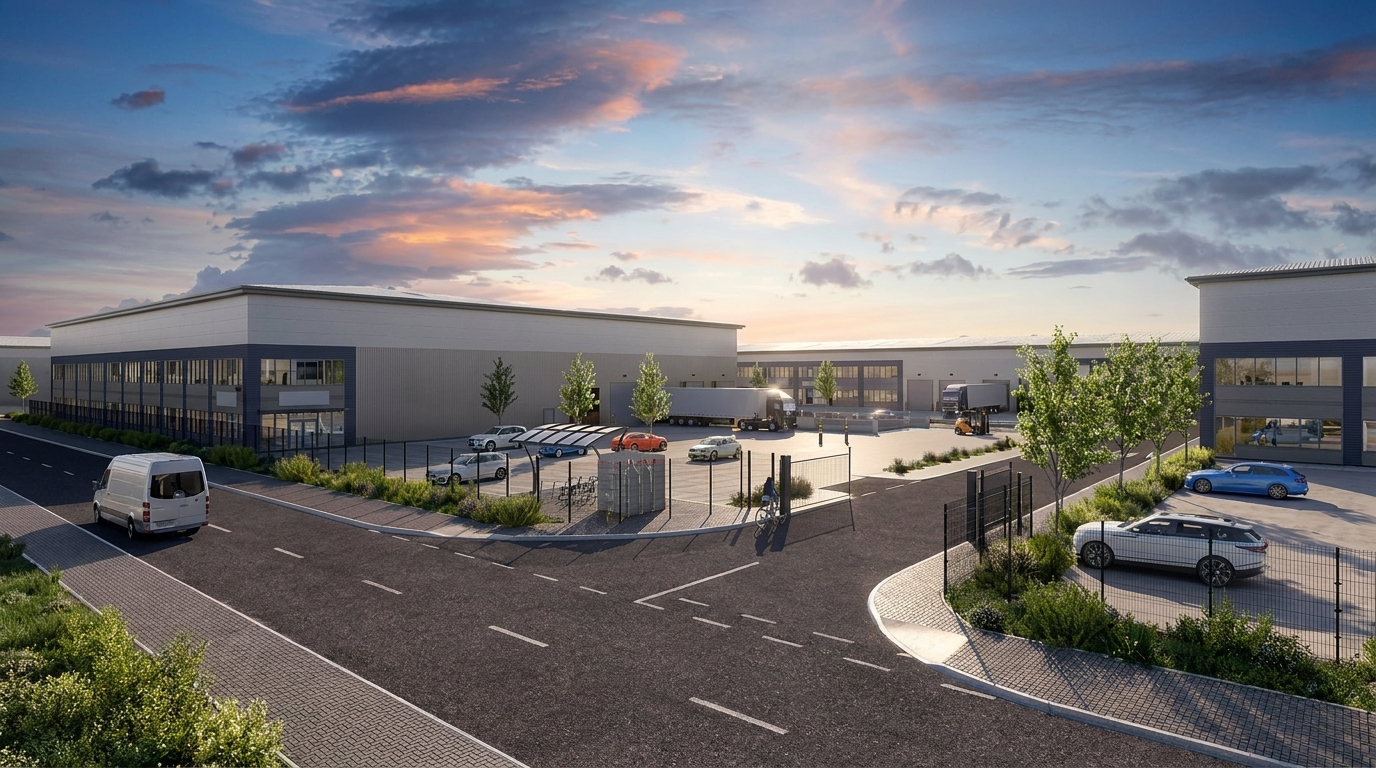
The specification drives the cleaning method. Clear internal heights run between 7 and 10 metres. The units include Grade A office space, electric loading doors and floor loading capacity up to 50kN per square metre.
The scheme also targets a BREEAM Excellent rating and an EPC A rating. BREEAM Excellent sits near the top of a scale that runs from Pass through Good, Very Good and Excellent to Outstanding, as BRE sets out in its guide to how BREEAM works. A building at that specification arrives at handover with a finish standard to match.
Those internal heights shaped the whole programme. High level access became the deciding factor in three of the four builders clean phases.
Phase one: cladding cleaning by reach and wash
The first phase ran for three weeks from 1 July. New cladding collects dust, mortar splash and site debris across a twelve month build, so the external envelope needs a full clean before anyone assesses the finish or brings an occupier round.
SSH used a reach and wash system for this. Telescopic poles fed with purified water let operatives clean glazing and cladding faces from ground level across large elevations, and the purified water dries clear on both glass and coated cladding.
Why ground level access was the right call
The method follows the HSE hierarchy in order. HSE guidance opens with a plain question: can you avoid working at height in the first place? Its first recommendation is to do as much work as possible from the ground, and it names extendable tools used from ground level as a practical example in its step-by-step guide to controlling work at height risks.
The safety case behind that hierarchy is a serious one. Work at height remains the biggest single cause of fatal and serious injury in the construction industry, and over 60% of deaths during work at height involve falls from ladders, scaffolds, working platforms and roof edges, according to HSE guidance on assessing work at height. On elevations of this size, choosing a method that keeps operatives on the ground removes the exposure rather than managing it.
There is a commercial argument alongside the safety one. Reach and wash needs no scaffold, no MEWP hire and no permit for each lift, so the phase moves faster and sits more easily alongside other trades still working the external areas.
Phase two: the warehouse builders clean up to second purlin
This phase also ran for three weeks, starting 6 July and overlapping the cladding work.
Purlins are the horizontal members that carry the roof sheeting. A specification written “up to second purlin” sets the vertical limit of the clean, which gives everyone a measurable line to work to and settles the scope question before anyone prices it. On units with 7 to 10 metre clear heights, that line sits well above working reach, so the phase runs on mechanical access.
A warehouse builders clean at this level covers structural steelwork, high level cladding faces, roof lights, service runs, and the full floor area underneath. The order within the phase runs top to bottom, because dust travels downward through a building. Cleaning the slab first wastes the effort twice over.
This is the builders clean phase most often underestimated on industrial schemes. A 52,959 sq ft unit with a 10 metre eaves height holds a volume of air and a surface area that bear little relation to the floor plan on the drawing.
Phase three: the internal builders clean and post construction cleaning
Two weeks from 13 July, covering the office and ancillary areas across the units.
Grade A office space carries a higher finish expectation than a warehouse floor, so this stage works through glazing, frames, sanitary ware, ceilings, floor coverings and the detail around door sets, skirtings and service plates.
Post construction cleaning at this point lifts the residue that builds up through fit out. Plaster dust, adhesive, paint spots, protective film and label glue all need removing, and much of it responds to specific methods rather than general cleaning.
The timing carries the risk. Other trades were still active, so the phase was programmed to give following works room while holding the completed areas at handover standard. Sequencing this stage too early means paying for the same area twice.
Phase four: the sparkle clean before handover
Two weeks from 4 August, running through the first half of the month.
A sparkle clean is the final clean before a unit goes in front of the client or an incoming occupier. It is the last stage of the builders clean programme, and it reinstates the finish after snagging, remedial works and the traffic of the preceding weeks. Every phase before it prepares the ground; this is the one the occupier actually sees.
The order of the four phases matters more than any single phase in isolation. Cladding first, then the warehouse from the roof down, then the internal areas, then the sparkle. Each stage protects the one before it, and the sparkle clean lands last so the finish presented at handover is the finish the programme paid for.
Saltbox units are available to occupiers from August 2026, which is the window the sparkle phase was built around.

What this means if you are handing over an industrial scheme
Four builders clean phases across one scheme could sit with four different suppliers. Splitting them that way creates four sets of RAMS, four inductions, four points of contact and four programme dependencies for a site manager to hold together while the build is at its busiest.
Running them through one contractor collapses all of that. The reach and wash team, the high level warehouse crew and the internal and sparkle teams work to a single programme, and one point of contact owns the sequencing.
For a quantity surveyor, that changes the risk profile. A builders clean delivered at the wrong point in the sequence means paying for the same area a second time, and on an eleven unit scheme that repeats. For a site manager, it takes a coordination job off the list at the point in the programme where the list is longest.
SSH Cleaning and SSH Building work from the same office. Building remedials, cladding cleaning, gutter clearance and all four cleaning phases come through one route, which is the practical version of one call for everything. On a scheme with 11 units and a fixed availability date, that is worth more than a lower line item.
Planning your next builders clean
Three things carry over from Saltbox to any industrial builders clean.
Sequence the phases from the outside in and the roof down, so each clean protects the last. Write the vertical limit into the specification, as the second purlin line did here, and the scope stays measurable for everyone pricing it. Plan high level access first, because the method chosen decides the safety case and the programme together.
SSH Cleaning delivers builders cleans, sparkle cleans, cladding cleaning and post construction cleaning across industrial, education, healthcare and commercial schemes, with SSH Building covering remedial and maintenance works from the same office.
If you have a scheme reaching handover in the next six months, book a site visit or ask us for a quote. Getting the cleaning phases into the programme early is what protects the handover date.